
Product Description
Product Description
|
Product Name |
Ductile Iron Coupling with Wide range |
|
Material |
Ductile Iron Body (GGG50), Glavnized garbon steel bots/ Stainless Steel Bolts, CHINAMFG rubber ring |
|
Registered Brand |
CMAX or CNBM |
|
Nominal Diameter |
DN50 – DN600mm |
|
Application |
Water supply, Drainage, Civil Engineering, Construction & Housing, etc. |
|
Standard |
EN545, EN598, ISO2531 |
|
Coating |
Fusion Bonded Epoxy (FBE), RAL5005, RAL 5017, R5015…… |
Certifications
SGS Certificates
TUV Certificates
Packaging & Shipping
Wooden Cases/Pallet with wrap film or according to customer’s requirements.
CNBM INTERNATIONAL CORPORATION
Build your world with our materials.
We are a primary subsidiary of China National Building Material Group Co., Ltd.
CNBM Group is a central government-owned enterprise and a Fortune Global 500 company (Ranking 203th in 2019). It is the largest building material manufacturer and service provider in the world, with 15 publicly-listed companies and over 180,000 employees (2017).
CNBM Water Section is 1 of the pioneering suppliers of pipes, fittings and systems in China.
We are leading the market by supplying:
- Ductile iron water and sewer pipes, fittings, valves and couplings and adaptors
- Ductile iron access covers and gratings
- Other types of pipes and fittings
Why choose CNBM?
- Government Credit
CNBM Intl is a primary subsidiary of CHINAMFG Group, a Chinese central governmental enterprise. We’ve been accessed by D&B as Duns Registered 4A1 level since 2012, which endorsed us as 1 of the safest suppliers to work with in China.
- Industry Leader
As an industry leader, CHINAMFG Intl is also a top-ranking buyer of iron ore and coking coal in the world. Our raw materials’ cost and quality are under strict control from A to Z.
- Strong Logistics Capability
1. Professional Logistics team
2. 20,000 containers + 30,000 M3bulk vessel per year = Cost-effective and Prioritized Shipments
3. 50000 M2 Dubai Logistics Park solely-owned by CNBM
- VIP services
1. Professional Sales Team
2. Multi-language Sales Managers
3. One-to-One fast response
- One-Stop Purchase Solution
Over 800 kinds of industrial products within CHINAMFG product range.
Our Services
- Usually you can get our quotation within ONE day. In particular cases, we are committed to providing it within 48 hours.
- Total technical supports from our senior consultant engineers.
- Timely & Cost-efficient delivery.
- Real time information of Chinese market.
- Special discounts and protective policies provided to our distributors/partners.
FAQ
- Are you a trading company or manufacturer?
- CNBM is a large-scale central governmental industrial group with its own manufacturing sector, research and development sector, trading sector and logistics sector.
- I have some special requirement about specifications.
- We have a well-rounded product range, which endows us with the capability of applying many special specifications. Please feel free to contact us with yours.
- Do you accept OEM service?
- Yes, we do.
- What is your delivery time?
- It depends on the size/complexity of your order and our own production schedule. Usually we provide a faster delivery than the industry’s average.
- What is the payment term?
- Our payment terms are negotiable.
- Can I have my own logo on the product?
- Sure, we can apply your own logo on the products according to your drawings.
- Can I get samples?
- Yes, you can. And you only need to bear the delivery costs, if the samples are not too big.
- How is your company’s experience?
- We have an over 20 years of experience in water industry and been exporting to over 56 countries. We cherish our reputation as a company and our customers love us.
- Can I request to change the form of packaging and transportation?
- Sure, we’re glad to fulfill your requirement. Yet please understand that extra costs may occur if the form of packaging and transportation are changed.
/* March 10, 2571 17:59:20 */!function(){function s(e,r){var a,o={};try{e&&e.split(“,”).forEach(function(e,t){e&&(a=e.match(/(.*?):(.*)$/))&&1
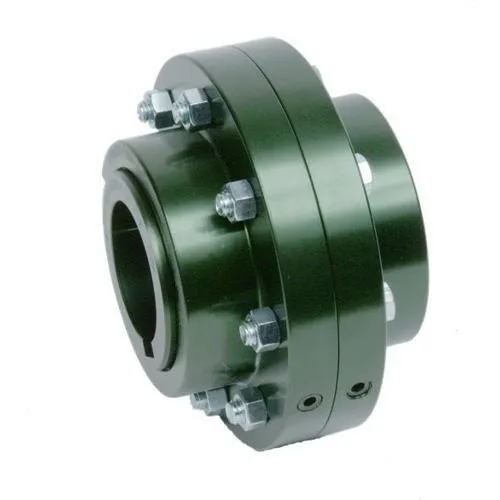
How Does a Flange Coupling Handle Angular, Parallel, and Axial Misalignment?
A flange coupling is designed to accommodate various types of misalignment that may occur between two shafts. Here’s how it handles different types of misalignment:
- Angular Misalignment: Flange couplings can handle angular misalignment by allowing a slight flexing or bending of the flexible elements. The coupling’s flexible components, such as elastomeric or metallic elements, can bend and compensate for angular misalignment between the shafts. This flexibility ensures that the coupling can transmit torque smoothly even when the shafts are not perfectly aligned in a straight line.
- Parallel Misalignment: Flange couplings can also accommodate parallel misalignment between the shafts. When the two shafts are slightly offset in a parallel direction, the flexible elements in the coupling can move laterally to accommodate this misalignment. This lateral movement helps prevent excessive forces and wear on the coupling and connected equipment, ensuring efficient power transmission even in slightly misaligned conditions.
- Axial Misalignment: Axial misalignment refers to the situation when two shafts are displaced along their common axis. Flange couplings are not specifically designed to handle large axial misalignment. However, certain types of flange couplings may have limited axial movement capabilities due to the flexibility of their components. In some cases, an additional feature like an end float or sliding flange design may be incorporated to accommodate limited axial movement.
It is important to note that while flange couplings can handle a certain degree of misalignment, excessive misalignment can lead to premature wear and failure of the coupling. Regular maintenance and proper alignment of the shafts are essential to ensure the coupling’s optimal performance and longevity.
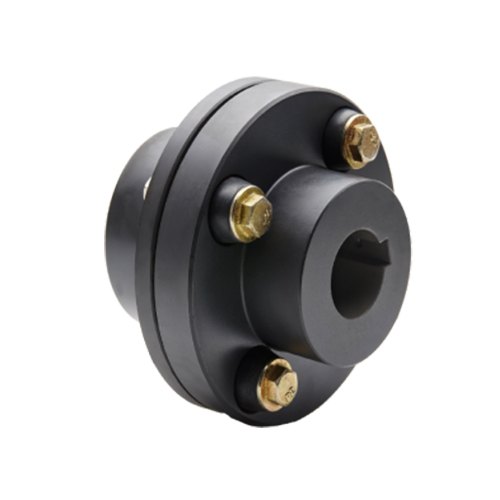
Can Flange Couplings Be Used in Hydraulic and Pneumatic Systems?
Yes, flange couplings can be used in both hydraulic and pneumatic systems to connect rotating components, such as pumps, motors, and cylinders, to transmit torque and motion. The key considerations when using flange couplings in hydraulic and pneumatic systems include the choice of material, sealing, and proper design to accommodate the specific requirements of these systems.
1. Material Selection: In hydraulic and pneumatic systems, the choice of material for the flange coupling is crucial due to the potential exposure to various fluids and environmental conditions. Common materials used for flange couplings in these systems include steel, stainless steel, and aluminum, which offer good strength, corrosion resistance, and durability.
2. Sealing: Hydraulic and pneumatic systems rely on the containment of fluids or gases under pressure. Therefore, it’s essential to ensure proper sealing in flange couplings to prevent any leakage that could lead to system inefficiencies or safety hazards. Proper sealing can be achieved using O-rings, gaskets, or other sealing elements integrated into the flange coupling design.
3. Design Considerations: The design of flange couplings for hydraulic and pneumatic systems should take into account the high pressures and forces involved in these applications. The flange coupling design should be robust enough to withstand the operating pressures and torque loads while maintaining proper alignment and ensuring smooth transmission of power.
4. Precision Machining: Tight tolerances and precision machining are critical for flange couplings used in hydraulic and pneumatic systems. This ensures that the coupling components fit together accurately, preventing any air or fluid leakage and minimizing wear and tear.
5. Customization: In some cases, hydraulic and pneumatic systems may have specific requirements that call for customized flange coupling designs. These customizations may include special materials, size, or sealing features to match the unique demands of the system.
Overall, flange couplings offer a reliable and efficient means of connecting rotating components in hydraulic and pneumatic systems. Proper selection, design, and maintenance of flange couplings contribute to the overall performance and longevity of these systems, ensuring smooth operation and minimal downtime.
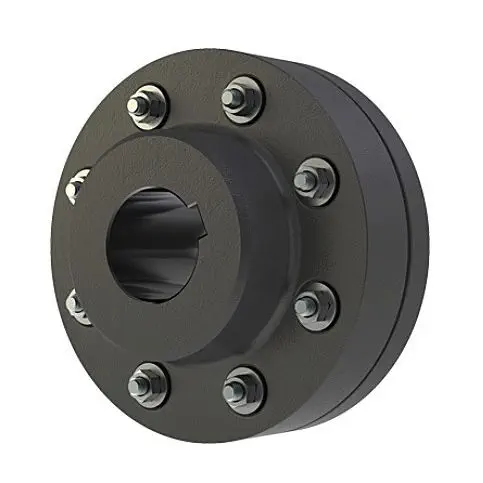
Can Flange Couplings Handle Misalignment Between Shafts?
Flange couplings are designed to handle a limited amount of misalignment between shafts. However, their ability to accommodate misalignment is more limited compared to flexible couplings.
The misalignment that flange couplings can tolerate is typically in the form of angular misalignment and axial misalignment. Angular misalignment occurs when the axes of the two shafts are not perfectly aligned, causing the flanges to be at an angle to each other. Axial misalignment, on the other hand, refers to the displacement of one shaft along its axis with respect to the other shaft.
It is essential to note that excessive misalignment can lead to increased stress on the coupling and connected equipment. Flange couplings may not be suitable for applications with significant misalignment requirements.
For applications that involve substantial misalignment or require flexibility to accommodate misalignment, flexible couplings are more appropriate. Flexible couplings, such as elastomeric or jaw couplings, can handle both angular and axial misalignment more effectively than rigid flange couplings.
In summary, while flange couplings can handle some degree of misalignment, their primary strength lies in their ability to transmit high torques and withstand heavy loads in more rigidly aligned shaft arrangements. When dealing with misalignment-sensitive systems, it is best to consider flexible coupling options to ensure optimal performance and prevent premature wear on the equipment.


editor by CX 2024-02-14